
Quick Answer
The 80/20 rule in video editing means about 80% of your video's impact comes from just 20% of your editing work. That vital 20% is your story, your best clips, clean cuts, sharp pacing, and clear audio. The other 80% of effort, like heavy effects and endless tiny tweaks, adds far less. It works by forcing you to spend your energy where it truly counts, then stop before you waste hours on details viewers never notice. This is how a professional video editing company in Delhi like Nimmio delivers polished, on brand videos faster and at better value. |
Table of Contents
What Is the 80/20 Rule in Video Editing?
How Does the 80/20 Rule Work?
Step by Step Guide (With Tools) to Apply It
Why Is the 80/20 Rule So Important?
Case Study: How Video Content Defines a Brand
Which Industries Must Do Video Marketing?
Work With Nimmio
Frequently Asked Questions
What Is the 80/20 Rule in Video Editing?
The 80/20 rule, also called the Pareto Principle, is a simple idea with a long history. In the late 1800s the Italian economist Vilfredo Pareto noticed that roughly 80% of the land in Italy was owned by about 20% of the people, and the same lopsided pattern showed up almost everywhere. Over time it became a trusted rule of thumb: most of your results come from a small part of your effort.
Applied to editing, the message is freeing. You do not need to treat every second with the same care, because a handful of key decisions shapes how the whole video feels. Once you learn to spot that vital 20%, you edit faster and your videos still look great. This habit separates rushed amateur work from professional video editing services that clients trust.
How Does the 80/20 Rule Work?
In practice the rule shows up at almost every stage of an edit. The trick is to pour your energy into the choices that move the needle and go light on the rest. Here is where it applies most:
Footage selection: Often only about 20% of everything you shoot makes the final cut, yet that small set of clips carries most of the story and emotion.
Effects and transitions: Polishing your key moments, roughly 20% of the timeline, lifts most of the viewer's sense of quality. Spreading heavy effects everywhere usually distracts.
Audio and pacing: Clean sound and good rhythm are a small part of the work but a huge part of how professional a video feel.
Templates and batching: Reusable intros, outros, and graphics cover about 20% of the structure but speed up 80% of repeat projects.
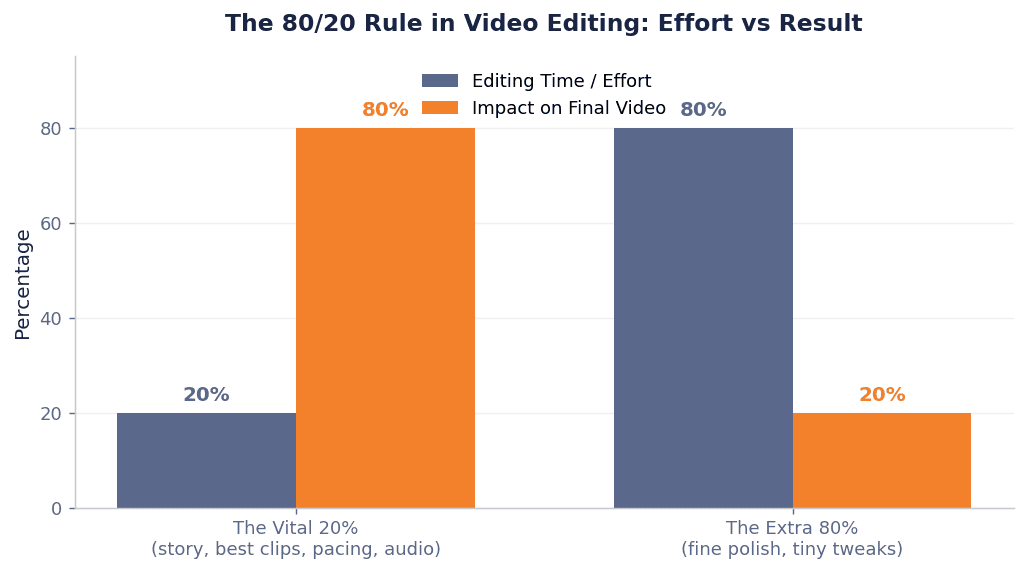
Chart: a small share of focused editing effort drives most of the final impact.
Step by Step Guide (With Tools) to Apply It
You do not need fancy software to use the 80/20 rule. You need the right order of work. Follow these steps on your next project:
Step 1 Sort your best clips. Watch your footage once and mark only the strongest 20%. These are your emotional, clear, and action-packed shots. Tools: any editor's marker or rating feature works, from Cap Cut to Premiere Pro.
Step 2 Lock the story first. Arrange those clips in the right order and build a rough cut before adding a single effect. If the story works silent, it will work polished. Tools: DaVinci Resolve or Premiere Pro for the timeline.
Step 3 Fix the audio early. Clean the sound, balance music, and remove noise. Viewers forgive weak visuals faster than bad audio. Tools: Adobe Podcast Enhance or Audacity, both free.
Step 4 Nail the first three seconds. Spend real time on your hook. This tiny slice of the timeline decides whether people keep watching. Tools: Cap Cut for fast text and captions.
Step 5 Add light polish only where it counts. Apply color and effects to your key moments, not the whole timeline. Tools: DaVinci Resolve for color grading.
Step 6 Use templates to save time. Reuse your intro, outro, and lower thirds so you never rebuild the basics. Tools: Canva or built in editor presets.
Step 7 Set a stop point and export. When the video clearly does its job, stop tweaking and ship it. Tools: your editor's export preset for the target platform.
This same disciplined workflow is what good video editing services use to deliver more videos without dropping quality.
Why Is the 80/20 Rule So Important?
For businesses and creators, this rule is a time saver, a money saver, and a quality guard. Here is why it matters:
It saves hours: Editing has a point of diminishing returns where extra time gives tiny gains. The rule tells you when to stop.
It protects quality: By focusing on story, hook, pacing, and audio first, your video is strong even before polish.
It lowers cost: Less wasted effort means faster delivery and better value, which is why a smart video editing company in Delhi can offer quick turnarounds.
It scales output: Templates and focus let a team produce many videos a week instead of perfecting one for a fortnight.
As the creator MrBeast has put it, it is easier to get millions of views on one great video than to spread the same effort thinly across a hundred average ones. That single idea is the 80/20 rule in action.
Case Study: How Video Content Defines a Brand
Video does more than inform. It shapes how people feel about a brand and pushes them to act. Consider a mid-sized business that switched from plain photo posts to focused video content.
From Ignored to Unmissable A growing brand was posting flat product photos with little response. They shifted to a simple video strategy built on the 80/20 rule: a strong three second hook, their best product moments, clean audio, and a clear call to action. They ignored fancy effects and focused only on the vital few elements. The content did three jobs at once. Customer review videos-built trust because real faces feel honest. Promotional videos explained the product fast and drove clicks. Event live shoot clips gave the brand energy and made it feel current and human. The result was a brand that finally looked professional and consistent. Engagement climbed, the audience remembered them, and the videos became the clearest expression of who they were. That is the real power of video content: it does not just show a service; it defines the brand and becomes the solution to being ignored. |
The lesson is simple. Focused, well edited video is one of the strongest tools a brand has, and partnering with experienced video editing services turns raw footage into that kind of brand defining content.
Which Industries Must Do Video Marketing?
Almost every business benefit from video, but some industries simply cannot compete without it. If you are in any of these fields, video marketing is no longer optional:
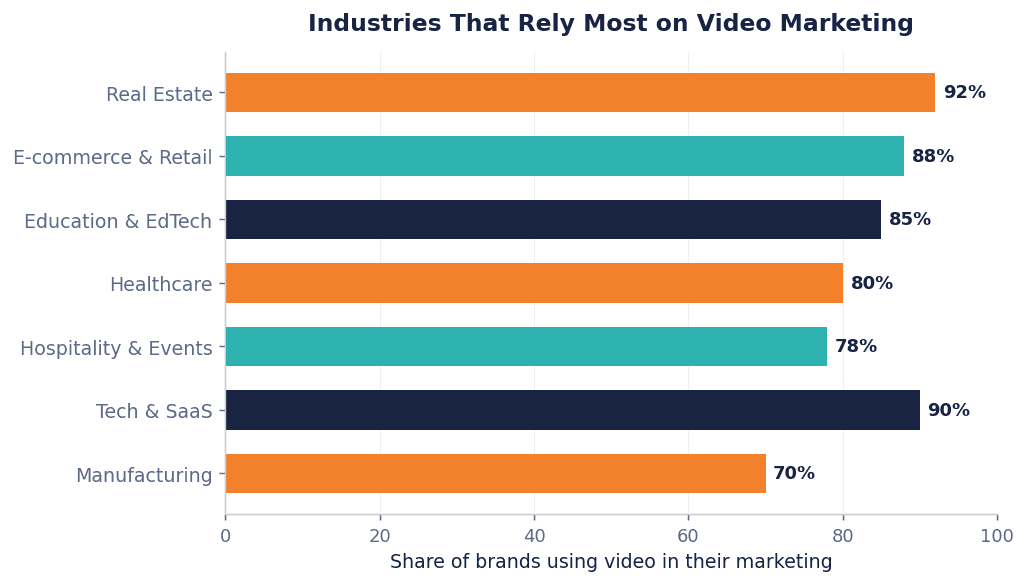
Chart: industries where video marketing has become essential for growth.
Real estate: Walkthrough tours and drone shots sell properties faster than any photo gallery.
E commerce and retail: Product videos, reviews, and promotional clips lift trust and conversions directly.
Education and EdTech: Explainer and course videos are the core product, not an add on.
Healthcare and clinics: Patient review videos and doctor introductions build the trust this sector lives on.
Hospitality and events: Event live shoot coverage and highlight reels capture energy and win future bookings.
Technology and SaaS: Demo and explainer videos turn complex features into something people instantly understand.
Across all of these, the winning formats are the same three: review videos that build trust, promotional videos that drive action, and event live shoot content that makes a brand feel alive. Each one works best when edited with the 80/20 discipline, so the message lands in seconds.
Work With Nimmio
Nimmio is a Delhi NCR based creative studio that turns raw footage into polished, on brand videos using exactly these principles. As a trusted video editing company in Delhi, we handle everything from story and cutting to color, sound, and final delivery, so you get sharp results without the wasted hours. Whether you need customer review videos, promotional films, event live shoot coverage, or explainer content, our video editing services combine smart tools with human taste. Businesses choose Nimmio because we apply the 80/20 rule on every project, which means faster turnaround, honest pricing, and video that actually defines and grows your brand.
Frequently Asked Questions
Q. What does the 80/20 rule mean in video editing?
A. It means about 80% of your video's quality and impact comes from roughly 20% of your editing effort, which is your story, best clips, pacing, and clean audio. You focus their first and go light on the rest.
Q. Is the 80/20 split an exact number?
A. No. The figures are a guide, not a law. Sometimes it is closer to 70/30 or 90/10. The point is the pattern: a small part of the work drives most of the result.
Q. Does the 80/20 rule mean editing carelessly?
A. Not at all. It means editing more carefully on what matters most and stopping before you waste time on details viewers never notice. It is smarter effort, not lazy effort.
Q. Which tools help me apply the 80/20 rule?
A. Free tools like Cap Cut, DaVinci Resolve, Audacity, and Adobe Podcast Enhance cover most needs. The tool matters less than the order of work: story and audio first, polish last.
Q. Why should a brand invest in professional video editing?
A. Because focused, well edited video builds trust, explains offers fast, and defines your brand. Professional video editing services deliver that quality quickly and consistently.


Let’s continue to stay connected.
Discover more about high-performance web design. Follow us on Twitter and Instagram.