
By Nimmio Editorial Team | Updated: 09 july 2026 | 15 min read
Quick Answer
Neither one wins every time. In 2026, the honest answer is that human voice over is better for emotion, trust, and brand work, while AI voice over is better for speed, low cost, and high volume. Real data backs this up: people are more than twice as likely to trust a human voice (55%) over AI (23%) and information recall more than doubled, from 14.3% to 32.5%, when a human voice was used. The smart move is to hire a good voiceover service agency that uses both, matching the right voice to the right job. |
Table of Contents
What is the difference between human and AI voice over?
Which one sounds more real in 2026?
Which is cheaper, human or AI voice over?
Which one builds more trust with your audience?
What do the latest trends and numbers show?
Case study: what happened in a real blind test?
When should you choose each one?
So, which is better for your project?
Frequently Asked Questions
1. What is the difference between human and AI voice over?
At the simplest level, a human voice over is recorded by a real person in a studio, while an AI voice over is created by software that turns text into speech. Both give you a finished audio file, but they get there in very different ways, and that changes how they feel to a listener.
Human voice over: A trained artist reads your script, adds emotion, and responds to creative direction like “make this line warmer.” You get personality and a real performance.
AI voice over: A text to speech tool generates the audio in seconds. You can pick from hundreds of voices and languages, and regenerate as many times as you like.
Think of it this way. A human is like a live musician who feels the song, while AI is like a very good keyboard that plays the notes perfectly but does not feel them. Both are useful, just for different moments.
2. Which one sounds more real in 2026?
This is where things have changed fast. A few years ago, AI voices sounded robotic and flat. Today, top tools produce speech with natural pauses and breathing that is hard to spot. In fact, in blind tests, many listeners simply cannot tell the difference for plain narration.
But there is a catch. AI still tends to flatten at the exact moments that matter most, such as irony, warmth, urgency, and comedic timing. For a simple explainer, AI often sounds great. For an emotional brand film or a heartfelt appeal, a human voice still pulls ahead because it truly performs the words rather than just reading them.
3. Which is cheaper, human or AI voice over?
On paper, AI is far cheaper, and it is not even close for high volume work. But the full picture depends on the type of project and hidden costs like licensing and editing.
AI cost: Roughly $0 to $30 per project, or a monthly plan around $5 to $99. For an 80,000-word audiobook, AI can cost as little as $40 to $250 and finish in under an hour.
Human cost: Around $50 to $5,000 per project depending on usage and length. The same audiobook read by a human can cost $2,400 to $6,000 and take four to six weeks.
The hidden part: For ads, human voice over with clear usage rights is safer and cleaner, because AI voice licensing for broadcast can get complicated and sometimes costs extra.
So, AI wins on raw price, especially at scale. But for a single high-stakes video where the wrong tone could hurt your brand, a human read can actually save money by avoiding a costly redo.
4. Which one builds more trust with your audience?
This is the strongest point in favour of humans, and the research is clear. When money, health, or brand reputation is on the line, people simply trust a human voice more. Look at the numbers below, drawn from recent industry studies.
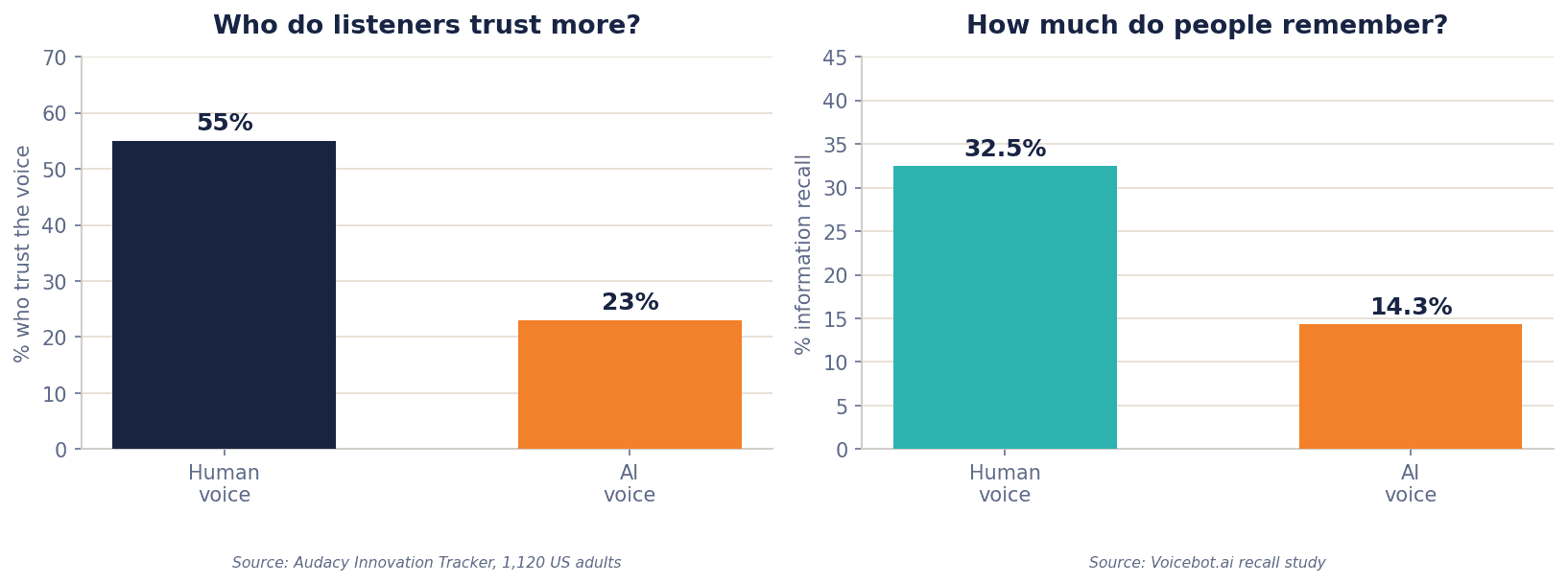
Human voices lead on both trust and memory in recent industry research.
According to Audacy's Innovation Tracker survey of 1,120 US adults, people were more than twice as likely to trust a human voice at 55%, compared to just 23% for AI. Separate research co conducted by Voicebot.ai found that information recall more than doubled, from 14.3% to 32.5%, when a human voice was used instead of a synthetic one. If you want listeners to remember and trust your message, a voiceover service agency will usually steer brand and sales content toward a real human voice.
5. What do the latest trends and numbers show?
The market is not picking a winner. It is using both. Here are the clear trends shaping voice over in 2026.
The market is growing: The global voice over market is approaching $5 billion in 2026, and human artist bookings on marketplaces have grown even as AI took over the low end.
Hybrid is the new normal: The most common pattern is AI for drafts, prototypes, and high-volume internal content, then a human artist for the final public facing version.
AI adoption is real but limited: Many clients have tested AI, yet most still keep the majority of their work human, especially for anything customer facing.
Consistency is AI's edge: AI never gets tired and sounds identical across hundreds of files, which is perfect for e learning modules and product updates.
6. Case study: what happened in a real blind test?
Crowd React Media study (2026) A media research firm played identical radio station promos to 1,326 weekly radio listeners aged 18 to 45 across the US. Half heard a professional human voice actor, and half heard an AI generated voice, without knowing which was which. The result: Before the reveal, there was no statistically significant difference in whether listeners could tell human from AI. The AI voice passed the blind test on pure sound. The twist: The moment listeners were told a voice was AI, their feelings changed. One third said they would feel less favourably toward a station using AI voices. Trust dropped once the label appeared. |
The lesson is simple and powerful. AI can now match humans on sound, but not yet on trust. Audiences accept AI as a production tool, yet they still want a human connection when it comes to brands and personalities they care about.
7. When should you choose each one?
Instead of asking, which is better overall, ask which is right for this specific job. Here is a quick guide.
Choose AI voice over for: rough drafts and scratch tracks, internal training videos, high volume low-stakes content, quick prototypes to test pacing, and multilingual content at scale.
Choose human voice over for: commercials and brand films, emotional or persuasive scripts, long form narration like audiobooks, and anything where trust and tone drive results.
If you are searching for voiceover services near me and feel unsure, a good studio will listen to your goal first, then recommend the right mix rather than pushing one option. That honest advice is worth a lot.
8. So, which is better for your project?
Human voice over is better when emotion, trust, and brand image matter most. AI voice over is better when speed, cost, and volume matter most. Neither one is the universal winner, and in 2026 the smartest brands stopped choosing sides and started combining both.
Nimmio Studio is a Delhi NCR based creative house that helps you get exactly this balance right. As a full-service voiceover service agency, Nimmio offers experienced human artists across English, Hindi, and regional languages, plus smart AI tools for fast drafts and high-volume work, all under one roof. If you have been looking up voiceover services near me with clear pricing and no guesswork, Nimmio matches the right voice to your goal, so your message sounds professional and earns real trust.
Frequently Asked Questions
Q. Is AI voice over better than human voice over?
A. Not overall. AI is better for speed, cost, and high-volume content, while human voice over is better for emotion, trust, and brand work. Research shows people trust human voices more than twice as much, so the right choice depends on your goal.
Q. Can people tell the difference between AI and human voices?
A. For plain narration, often no. Blind tests in 2026 show many listeners cannot spot the difference on sound alone. But for emotional or persuasive content, humans still stand out, and trust drops once people know a voice is AI.
Q. Is AI voice over legal to use in ads?
A. It depends on the tool's license and your country's rules. Many AI tools charge extra for broadcast use or restrict it. A human artist can sign clear usage rights, which makes human voice over the safer path for paid media.
Q. Which is cheaper for a long audiobook?
A. AI is far cheaper. An 80,000-word book can cost as little as $40 to $250 with AI and finish in under an hour, while a human narrator may cost $2,400 to $6,000 and take weeks. For emotional storytelling, though, many still prefer a human.
Q. Can I use both AI and human voice over together?
A. Yes, and it is the most common approach in 2026. Teams use AI for drafts, prototypes, and internal content, then bring in a human artist for the final public facing version. A good voiceover service agency will help you plan this mix.


Let’s continue to stay connected.
Discover more about high-performance web design. Follow us on Twitter and Instagram.

