
By Nimmio Editorial Team | Updated: 24 july 2026 | 12 min read
Quick Answer
Video editing started in the 1890s, when filmmakers physically cut strips of film with scissors and joined them with glue or tape. Thomas Edison's Kinetograph in 1890 made moving pictures possible, and the Moviola in 1924 gave editors the first real editing machine. Magnetic videotape arrived with the Ampex recorder in 1956, the CMX-600 brought computers into editing in 1971, and Avid Media Composer introduced the modern digital timeline in 1989. Today AI handles cuts, captions, and colour automatically. What began as a craft of scissors and patience is now a core business tool used by 91% of companies. |
Table of Contents
1. Where Did Video Editing Begin?
2. The Four Great Eras of Editing
3. Why Does This History Still Matter?
4. Step by Step: How Editing Works Today (With Tools)
5. Case Study: How Video Built a Brand
6. Which Industries Must Use Video Marketing?
7. How Nimmio Helps
8. Frequently Asked Questions
Where Did Video Editing Begin?
Video editing began with a simple problem. Early filmmakers had rolls of film with separate moments on them and wanted to tell one connected story. The only solution was to cut the film physically and join the pieces in a new order.
It started in 1890, when Thomas Edison and his assistant William Dickson developed the Kinetograph, the first motion picture camera. By the early 1900s editors worked at a bench with scissors, cutting reels and joining them with glue or tape. Every cut was permanent, so a mistake meant real damage to the film.
This was called linear editing, because everything was assembled in order from start to finish. It was slow and demanded patience. Yet these first editors invented the visual grammar we still use, discovering that two shots placed side by side create meaning neither shot has alone.
The Four Great Eras of Editing
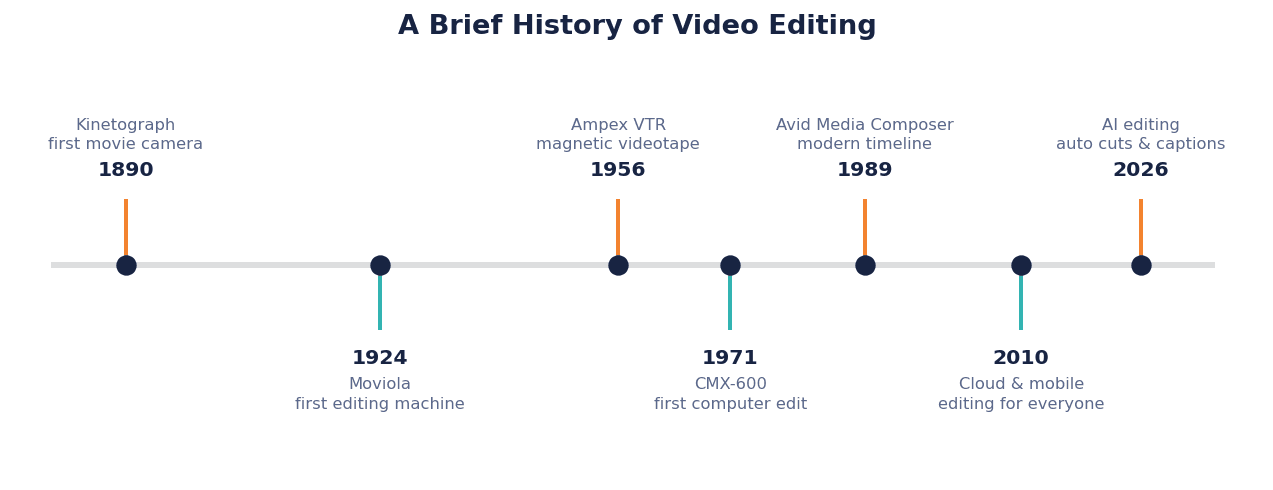
The journey runs through four clear stages, each making editing faster and more creative.
Era 1: Cutting and Splicing (1890s to 1920s)
Editors cut film by hand with scissors and joined strips with adhesive. Directors like Sergei Eisenstein built entire theories of storytelling here, proving the order of shots controls how an audience feels.
Era 2: Flatbed Machines (1920s to 1970s)
The Moviola arrived in 1924 as the first machine built specifically for editing, letting editors watch footage while they worked. Later flatbed tables like the Steenbeck and KEM used motorised plates, making long sequences far easier to review.
Era 3: Videotape (1950s to 1980s)
Magnetic videotape changed television. When Ampex launched its Video Tape Recorder in 1956, broadcasters could record and edit electronically instead of developing film. Tape was cheaper, faster, and reusable, which is why TV production exploded.
Era 4: Digital and Non-Linear (1970s to Today)
The CMX-600, launched in 1971 by CBS and Memorex, first brought computers into editing. Lucasfilm's EditDroid followed in the 1980s and introduced two ideas we take for granted: the timeline and thumbnail clip icons.
The turning point came in 1989 with Avid Media Composer. It stored footage on hard drives and allowed non-destructive edits, so you could cut and rearrange endlessly without harming the original. Adobe Premiere followed in 1991 and Final Cut Pro in 1999. This is non-linear editing, because you jump to any moment instantly with no rewinding.
Why Does This History Still Matter?
This is not just trivia. Every era removed a barrier, and the result is that any business can now tell a professional story on screen. The numbers show how central this has become.
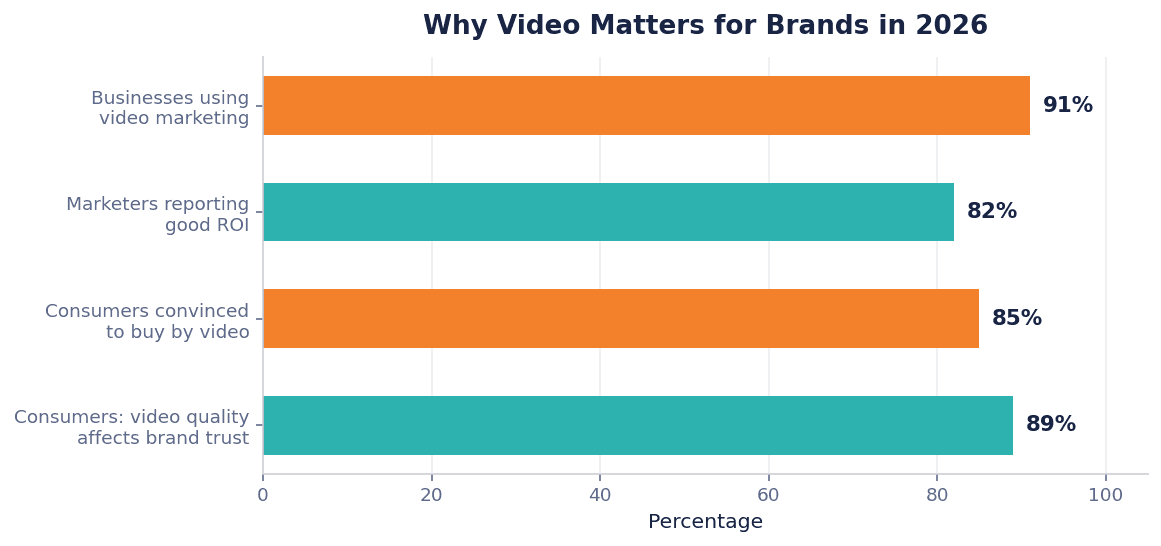
Video has moved from a creative luxury to a baseline business requirement.
Video is now standard: Around 91% of businesses use video marketing, and roughly 82% report good ROI.
It drives real decisions: About 85% of consumers say a video has convinced them to buy a product or service.
Quality signals trust: Close to 89% say video quality affects brand trust, so a badly edited video costs your credibility.
It lifts conversions: Landing pages with video convert far better than text only pages.
The lesson is simple. Editing was always the step that turned raw footage into meaning. That has not changed, only the tools have.
Step by Step: How Editing Works Today (With Tools)
The modern process follows a clear order. Here is the professional workflow with tools for each stage.
Step 1: Organise footage. Import all clips and label them clearly. Good organisation saves hours later. Tools: your editor's media bin.
Step 2: Build a rough cut. Lay your best clips on the timeline in story order, ignoring polish. Tools: DaVinci Resolve (free), Adobe Premiere Pro, Final Cut Pro, Cap Cut.
Step 3: Tighten pacing. Trim dead space and cut anything that does not move the story forward. Tools: Descript edits video by editing the transcript.
Step 4: Fix the audio. Clean noise, balance levels, add music. Viewers forgive weak visuals faster than bad sound. Tools: Audacity (free), Adobe Audition.
Step 5: Colour grade. Correct exposure and white balance, then apply one consistent look. Tools: DaVinci Resolve is the standard and free.
Step 6: Add graphics and captions. Insert titles, logos, and subtitles. Most social viewers watch on mute, so captions are essential. Tools: After Effects, Canva, auto caption tools.
Step 7: Export correctly. Match resolution and aspect ratio to each platform. Vertical for reels, horizontal for YouTube.
Case Study: How Video Built a Brand
From Invisible to In Demand Consider a mid-sized services company with a good product but almost no online presence. The website was text heavy, social pages posted static images, and enquiries were slow. Prospects could read what the company did but never see or feel it. The shift began with three types of videos. First, customer review videos, where real clients spoke about their results. Second, a short promotional film explaining the service clearly in under ninety seconds. Third, live shoot coverage of their annual event, cut into highlight reels for social media. The change was immediate. Video testimonials are trusted far more than written reviews, and viewers who watch a demo convert at much higher rates. The explainer cut down basic questions to the sales team, because prospects understood the offer before making contact. The deeper result was brand definition. Before video, the company was described in vague terms. After video, customers could point to a specific story, tone, and promise. Editing did that work by choosing which moments to keep and how to order them, exactly as editors have since the 1890s. |
Which Industries Must Use Video Marketing?
Some sectors cannot compete without video, because customers decide visually or need proof before buying.
Industry | Why Video Is Essential | Best Video Type |
Real estate | Buyers decide from visuals first | Walkthrough tours, promotional video |
Restaurants & hospitality | Food and ambience sell on sight | Reels, review videos |
Education & coaching | Trust and teaching quality must be shown | Explainer, student review videos |
Healthcare & clinics | Patients need reassurance and credibility | Doctor intros, patient reviews |
Manufacturing & B2B | Complex processes need demonstration | Factory walkthrough, product demo |
Events & weddings | The product is the experience itself | Event live shoot, highlight films |
Three formats do most of the heavy lifting. Review videos build trust because customers believe other customers. Promotional videos explain your offer quickly. Event live shoot coverage captures proof that something real happened, giving you content for months.
How Nimmio Helps
Nimmio is a Delhi NCR based video production and editing studio that carries this history forward for your brand. We handle everything from concept and scripting to shooting, editing, colour, sound and delivery, so you never manage separate vendors. We produce customer review videos, promotional films, corporate explainers, product demos, and full event live shoot coverage with multi camera setups, combining AI assisted speed with human judgement for story. If your brand needs video that defines who you are and converts viewers into customers, Nimmio turns raw footage into a message people remember.
Frequently Asked Questions
Q. When did video editing actually start?
A. It started in the 1890s. After Edison's Kinetograph appeared in 1890, filmmakers began cutting film strips with scissors and joining them with glue or tape to build stories.
Q. What was the first video editing machine?
A. The MO viola, introduced in 1924, was the first machine built specifically for editing film. It let editors view footage while cutting, which was a huge improvement over working blind at a bench.
Q. What is the difference between linear and nonlinear editing?
A. Linear editing means assembling everything in order on film or tape, where changes are permanent. Nonlinear editing stores footage digitally so you can jump to any clip instantly and rearrange freely without damaging the original.
Q. Which software started modern digital editing?
A. Avid Media Composer in 1989 is widely credited as the breakthrough. It introduced hard drive storage and non-destructive timeline editing, the workflow every editor still uses today.
Q. Why should my business invest in video now?
A. Because your customers expect it. Around 91% of businesses already use video, roughly 85% of consumers say video has convinced them to buy, and video quality directly affects how much people trust your brand.


Let’s continue to stay connected.
Discover more about high-performance web design. Follow us on Twitter and Instagram.